Caught Between Day and Dark: The Blue Hour's Extraordinary Gift to American Photography
Caught Between Day and Dark: The Blue Hour's Extraordinary Gift to American Photography
There is a particular kind of stillness that descends on American cities and landscapes in the minutes after the sun disappears. The sky does not go dark immediately. Instead, it deepens — moving through layers of violet and indigo before settling into a rich, diffused blue that photographers have long regarded as among the most cinematic natural light available to them. This interval, commonly called the blue hour, lasts far shorter than its name implies. In practice, photographers work with a window closer to fifteen minutes, sometimes less depending on the season and latitude. Yet within that compressed span, images become possible that simply cannot be replicated at any other moment of the day.
Understanding why requires a brief look at atmospheric physics — and the payoff for that understanding is a dramatically more intentional approach to one of photography's most rewarding pursuits.
The Science Behind the Glow
When the sun sits between roughly four and eight degrees below the horizon, it no longer illuminates the earth directly. What remains is indirect light — photons scattered by the upper atmosphere and filtered through a much greater depth of air than during midday hours. This extended path strips away the warm, long-wavelength reds and oranges that define golden hour. What survives is predominantly short-wavelength blue light, which scatters more readily and fills the sky with a soft, even luminosity.
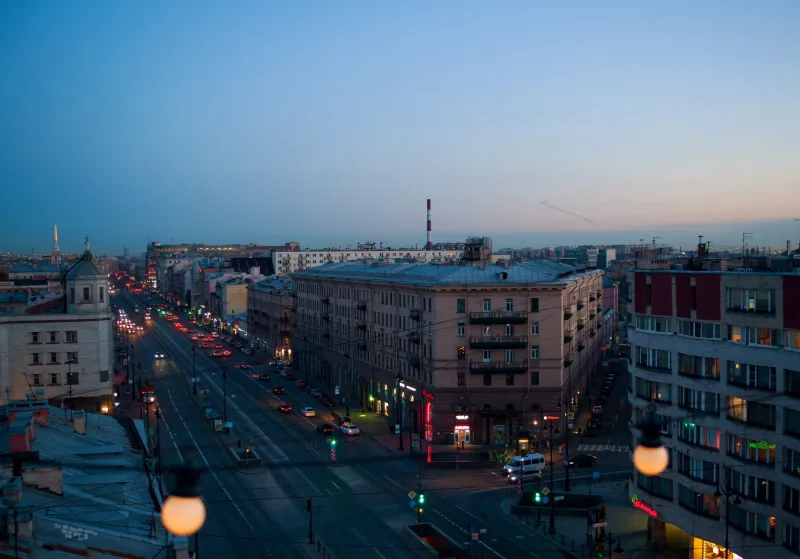
The result is a light source of remarkable quality: virtually shadowless, deeply saturated, and consistent across the entire sky. Artificial light sources — streetlamps, illuminated windows, neon signage, traffic — are still fully active during this window, and their warm tones contrast sharply against the cool blue ambient light. This interplay between warm artificial sources and cool natural sky is the defining visual signature of blue hour photography, and it is extraordinarily difficult to simulate in post-processing alone.
For photographers, the practical implication is significant. Exposure times lengthen considerably compared to golden hour, requiring either a tripod or deliberate use of higher ISO settings. The light also changes rapidly — often a full stop of exposure difference can occur within five minutes — which demands that photographers arrive prepared and work efficiently.
American Photographers Who Have Made It Their Medium
Several prominent American photographers have built sustained bodies of work specifically around this transitional light, treating the blue hour not as an occasional bonus but as a primary creative medium.
Urban landscape photographers working in cities like Chicago, Seattle, and New York have long recognized that the blue hour transforms cityscapes in ways that daytime shooting cannot approach. The skylines of these cities — already architecturally dramatic — take on an almost theatrical quality when their lit windows and illuminated facades glow against a deep blue sky. The geometry becomes sharper, the color relationships more vivid, and the sense of human habitation within vast urban structures more emotionally resonant.
In more rural and wilderness contexts, blue hour photographers working across the American Southwest have documented how the light behaves differently in open terrain. Without artificial light sources to compete with or complement the ambient blue, the effect becomes more austere and monolithic. Red rock formations in Utah and Arizona absorb and reflect the blue light in ways that appear almost surreal — landscapes that look entirely alien compared to their midday appearances.
Coastal photographers along both the Atlantic and Pacific shores have similarly noted that water surfaces during blue hour take on a reflective quality that amplifies the sky's color, creating a visual continuity between sea and atmosphere that can feel almost abstract.
Anticipating and Locating the Moment
Successful blue hour photography begins well before the sun sets. Preparation is not optional — it is the work itself.
The first step is identifying precise sunset times for your specific location and date. Apps and websites dedicated to astronomical data provide not only sunset times but also the exact moment when civil twilight ends, which corresponds closely to the conclusion of the blue hour window. Building a fifteen-minute working window backward from that endpoint gives photographers their target interval.
Location scouting in daylight is equally essential. Arriving at a prospective shooting location during the blue hour for the first time, without prior knowledge of sight lines, foreground elements, or compositional opportunities, is a significant disadvantage. Photographers who work the blue hour most effectively typically visit locations multiple times during ordinary daylight, mapping compositions mentally before the pressure of a shrinking window arrives.
For urban environments, identifying positions where artificial light sources appear within the frame — rather than outside it — is critical. A cityscape in which lit windows and street-level illumination play against the blue sky tells a more complete visual story than one where the artificial light exists only peripherally.
Technical Considerations in the Field
The blue hour demands a degree of technical rigor that more forgiving lighting conditions do not. Exposure accuracy matters more when the light is changing this quickly, and small errors compound rapidly.
A sturdy tripod is the most important piece of equipment a blue hour photographer can bring. Exposure times during this window frequently range from one to thirty seconds depending on the scene and desired depth of field, making handheld shooting impractical for anything requiring critical sharpness. A remote shutter release or the camera's self-timer function eliminates vibration introduced by pressing the shutter manually.
White balance is a subject of genuine creative debate among photographers who specialize in this light. Setting white balance to daylight or shade preserves the cool, blue-dominant tones that characterize the hour authentically. Some photographers prefer to push the white balance warmer, allowing artificial light sources to appear more prominently golden against a less intensely blue sky. Neither approach is objectively correct — the choice reflects the photographer's interpretation of the scene.
Bracketing exposures during the blue hour is a practical strategy given how quickly the ambient light shifts. Capturing three or five frames at different exposures at regular intervals throughout the window provides options in post-processing and protects against the rapid light changes that can render a single exposure obsolete within minutes.
The Creative Argument for Embracing Constraints
There is a broader creative principle embedded in blue hour photography that extends well beyond its technical particulars. The extreme time constraint — fifteen minutes or less — imposes a discipline that many photographers find clarifying rather than limiting. When the window is this narrow, decisions about composition, position, and exposure must be made with conviction. There is no time for prolonged hesitation.
Many photographers who work regularly in this light report that the urgency it creates sharpens their instincts over time. The necessity of arriving prepared, having scouted locations, and executing quickly builds a kind of creative confidence that carries into other photographic contexts.
The blue hour is, in this sense, more than a lighting condition. It is a training ground for the kind of decisive, prepared, visually literate practice that distinguishes photographers who consistently produce compelling work from those who wait for perfect conditions that never quite arrive.
At Clor Images, we believe that vision meets light most powerfully when the photographer understands both — and the blue hour offers one of the clearest demonstrations of that principle available anywhere in nature. The light is brief, the preparation is demanding, and the results, when everything aligns, are genuinely extraordinary.