The Art of Arrival Before the Moment: How America's Most Deliberate Photographers Master the Light They Cannot Control
The Art of Arrival Before the Moment: How America's Most Deliberate Photographers Master the Light They Cannot Control
There is a particular kind of stillness that settles over a photographer who has decided to wait. Not the restless pause between shots, nor the reluctant hesitation of someone unsure where to point the lens — but the composed, purposeful stillness of someone who has already seen the image in their mind and is simply allowing reality to catch up.
This is the practice of pre-visualization, and among a dedicated cohort of American photographers, it has become nothing less than a philosophy of making pictures.
Seeing Before Seeing
The concept is not new. Ansel Adams famously spoke of visualizing the finished print before the shutter ever opened, a mental discipline he considered inseparable from technical mastery. Yet in an era defined by the algorithmic speed of smartphone cameras and the relentless pressure to publish, the practice has taken on a fresh and almost countercultural significance.
Pre-visualization, in its contemporary application, extends well beyond a moment of mental rehearsal at the scene. For photographers like Denver-based landscape specialist Miriam Calloway, it begins days — sometimes weeks — before she arrives at a location with her camera.
"I'll drive out to a site at noon on a Tuesday just to understand the geometry," Calloway explains. "I'm watching where the shadows fall, how the ridgeline interacts with the sky, whether there are surfaces that will catch reflected light. I'm not there to photograph. I'm there to learn."
That learning, she argues, is what separates a found image from a made one.
The Scout as Creative Act
The scouting visit has long been standard practice in commercial and film photography, where budgets and schedules demand that nothing be left to chance. What distinguishes the pre-visualization practitioners profiled here is that they apply this same rigor to personal and fine-art work — contexts where spontaneity is often romanticized as authenticity.
Chicago street photographer Darnell Okafor spends considerable time walking his chosen corridors before committing to a shoot. His work, which documents the architectural transitions of the city's South Side neighborhoods, depends on a precise understanding of how afternoon light moves between buildings in different seasons.
"People look at my images and assume I just happened to be standing in the right place," Okafor says. "But that corner? I've been to that corner four times. I know exactly when the shadow line crosses the sidewalk. I know which days it's clean and which days it's cluttered with delivery trucks."
The images that result carry a quality of inevitability — as though the light had been arranged for the occasion. In a sense, it had been, though the arrangement took place entirely within the photographer's understanding of time and space.
Patience as Radical Practice
To frame patience as radical may seem paradoxical in a discipline built on observation. Yet the contemporary photographic landscape — shaped by social media platforms that reward volume and recency — actively discourages the kind of extended engagement that pre-visualization requires.
Portland-based photographer Sasha Reinhardt, whose long-exposure work along the Oregon coast has been exhibited at galleries across the Pacific Northwest, describes the pressure she felt early in her career to produce and publish constantly.
"There's this anxiety that if you're not posting, you're not working," she says. "But some of my most productive weeks are the ones where I don't press the shutter at all. I'm reading the weather patterns, I'm watching tide charts, I'm visiting the same stretch of beach at different hours. That's the work. The photograph is almost the last step."
Reinhardt's process occasionally spans a full lunar cycle. She tracks how moonrise interacts with specific rock formations, coordinating her shooting schedule with both astronomical data and seasonal weather forecasts. The images she produces — technically immaculate, atmospherically charged — bear the unmistakable signature of someone who refused to settle for approximation.
Light as a Moving Subject
At the core of pre-visualization is a fundamental reorientation of what a photographer considers the subject of their work. Light, in this framework, is not a condition to be managed but a subject to be understood — one with behavior, personality, and a schedule of its own.
Santa Fe-based photographer and educator James Whitfield teaches workshops built around what he calls "light literacy" — the ability to read an environment and predict how illumination will transform it over time.
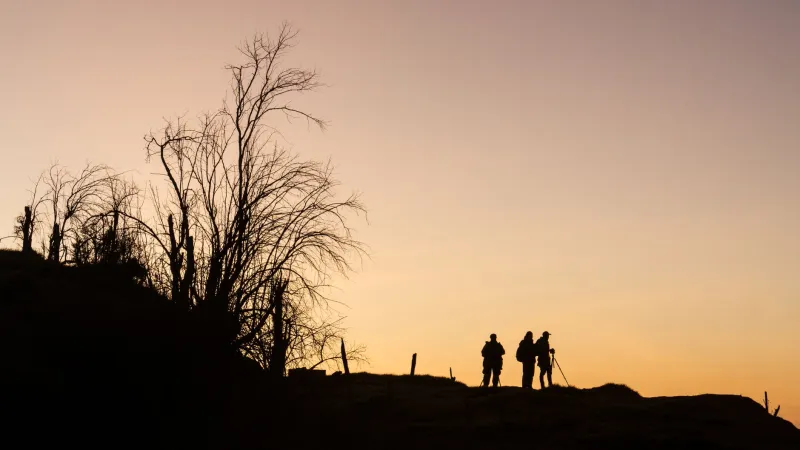
"Most photographers react to light," Whitfield says. "They show up and adjust. The photographers I most admire have learned to anticipate it. They know that in late October, at this latitude, the sun will drop behind that mesa at 4:47 in the afternoon and throw a rim of gold across the adobe wall for approximately eleven minutes. They're there at 4:30. They're ready."
This intimate knowledge of light's behavior transforms the creative process. Rather than hunting for images, these photographers cultivate them — returning to locations across seasons and years, accumulating an understanding that no single visit could provide.
The Dividend of Discipline
The results speak in a register that improvised capture rarely achieves. Images born of pre-visualization tend to possess a quality that viewers often struggle to articulate — a sense that everything within the frame belongs precisely where it is, that the light has been granted rather than borrowed.
That quality, these photographers suggest, is not accidental. It is the dividend of discipline, the visible evidence of time invested before the shutter opened.
For Miriam Calloway, the reward is not merely aesthetic. "When you've waited for something — really waited, really studied it — you have a relationship with that image before it exists. And that relationship changes how you see it when it finally arrives."
In a photographic culture that prizes the instant, the decisive millisecond, the reflexive capture, there is something genuinely provocative about a body of work built on deliberate postponement. These photographers are not waiting because they are uncertain. They are waiting because they are certain — certain that the light will come, certain that they will recognize it, and certain that the image they have already seen in their minds is worth every hour spent in preparation.
At Clor Images, we believe that where light meets vision, the most profound encounters are rarely accidental. The photographers profiled here have made that intersection their life's work — and the images they produce remind us that slowing down is not a retreat from photography. It may be its highest expression.