Glowing Witnesses: The Photographers Preserving America's Disappearing Neon Before the Last Tube Goes Dark
Glowing Witnesses: The Photographers Preserving America's Disappearing Neon Before the Last Tube Goes Dark
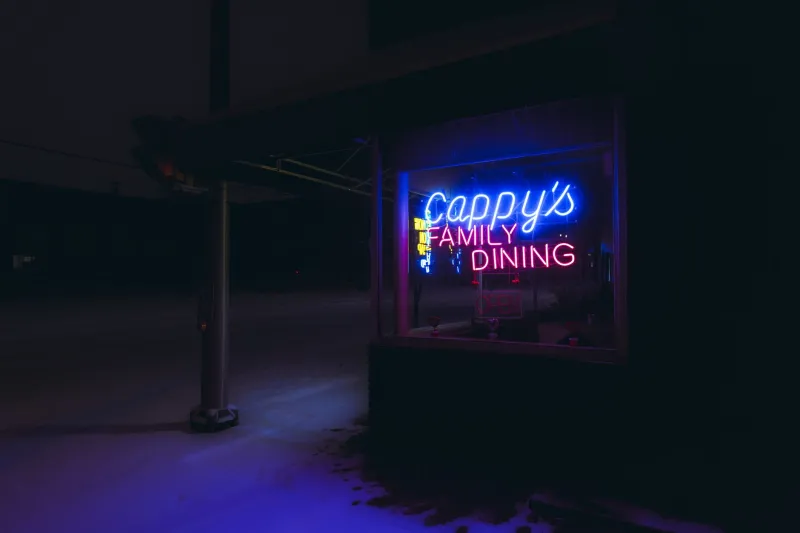
There is a particular quality of light that no LED panel has ever fully replicated. It breathes. It hums, faintly, behind glass. It saturates the surrounding air with a color so specific — that particular electric crimson, or the cool cerulean of a roadside motel sign — that the eye registers it not merely as illumination but as meaning. Neon light, at its best, is a form of handwriting: idiosyncratic, warm, and irreplaceable.
And it is disappearing.
Across the United States, thousands of neon signs are going dark each year. Business closures, municipal code changes, the prohibitive cost of neon repair, and the relentless march of cheaper LED alternatives have conspired to erase one of the most distinctive visual signatures of American commercial life. What remains — glowing above a Cincinnati diner, flickering outside a Tucson motel, blazing along a Memphis side street — is a diminishing inheritance. A growing number of American photographers have made it their mission to ensure that this inheritance is not lost without a record.
The Archive as Artistic Act
The photographers drawn to neon documentation occupy an unusual creative position. They are archivists, certainly, but they are also artists working with one of the most technically demanding light sources a camera can encounter. Neon presents exposure challenges that test even seasoned professionals: extreme dynamic range, color casts that shift unpredictably against ambient surroundings, and the ever-present risk that the subject itself — aging, fragile, often poorly maintained — may not survive long enough for a second visit.
Philadelphia-based photographer Marcus Teller has spent the better part of a decade traversing the Mid-Atlantic and Rust Belt states, cataloguing signage that spans from the 1930s through the 1980s. His approach is methodical. Before arriving at any location, he researches the sign's history through local newspaper archives, business licensing records, and the institutional memory of community historians. By the time his camera is positioned, he understands not only what he is photographing but what it once meant to the neighborhood around it.
"The light tells you part of the story," Teller has said in public discussions of his work. "But the context tells you the rest. A neon pharmacy sign from 1952 in a neighborhood that has changed three times over — that's not just a pretty object. That's a palimpsest."
Technical Mastery in Service of Memory
Capturing neon well demands a specific technical fluency. The photographers engaged in this work have, through necessity, developed refined approaches to a set of recurring challenges.
Exposure bracketing is standard practice. Because neon tubing can be exponentially brighter than the surfaces surrounding it, a single exposure almost always sacrifices either the sign's internal glow or the contextual detail of the building and street behind it. Many photographers shoot in RAW format across a wide exposure range and blend the results in post-processing, preserving both the luminous core of the sign and the architectural or environmental narrative that gives it meaning.
White balance presents its own complications. Neon gas mixtures produce colors that do not correspond neatly to standard color temperature presets. Argon and mercury produce blues and purples; pure neon yields the iconic red-orange; helium, krypton, and various phosphor coatings extend the palette further. Photographers working in this space frequently shoot with a neutral white balance and correct selectively in editing, preserving the sign's true chromatic character rather than allowing the camera's automatic systems to neutralize what is, in fact, the entire point.
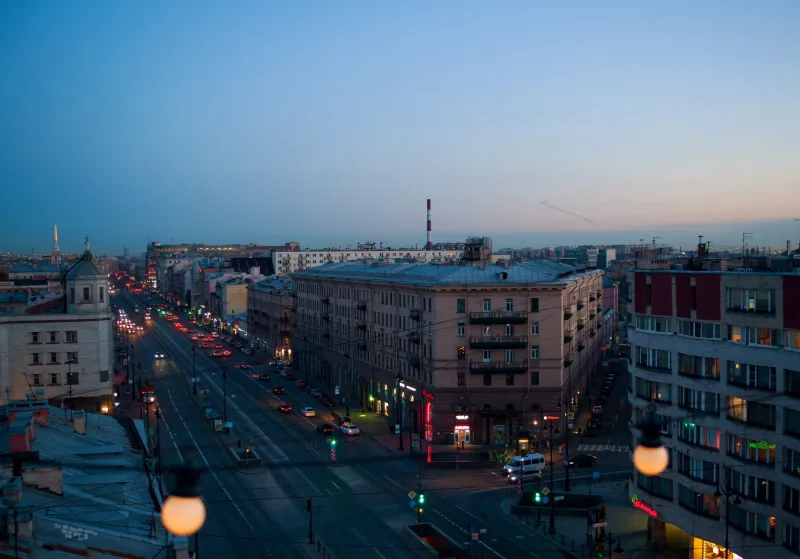
Timing, too, is critical. The most celebrated neon photographs tend to be made during the brief window photographers call civil twilight — that interval after sunset when the sky retains enough ambient blue to balance the artificial warmth of the signs without overwhelming them. During full darkness, neon can appear isolated, unmoored from its surroundings. In daylight, the tubes lose their luminous authority entirely. The window of ideal conditions may last no more than fifteen minutes, and it demands preparation, patience, and often multiple visits to the same location across different seasons.
Cultural Resonance and the American Visual Imagination
Neon holds a particular place in the American visual imagination that goes beyond mere nostalgia. It is bound up with specific chapters of the national story: the postwar optimism that lit up Route 66 with roadside attractions and motor courts; the urban commercial vitality of mid-century cities where every block competed for attention through increasingly elaborate signage; the particular aesthetic of American vernacular architecture that said, implicitly, that commerce and spectacle were not incompatible.
For many of the photographers engaged in this archival work, the cultural dimension is inseparable from the photographic one. Chicago-based documentarian Renata Sokolowski, whose ongoing series "Last Light" has been exhibited at regional photography festivals across the Midwest, frames her project explicitly in terms of civic identity.
"These signs were made by local craftspeople for local businesses," she has explained. "They were designed to speak to a specific community on a specific street. When they go, something genuinely irreplaceable goes with them. The photograph doesn't replace the object, but it insists that the object mattered."
This insistence — that the overlooked and the aging deserve the same careful visual attention as the celebrated and the new — is at the heart of what serious photography has always offered. The neon archivists are working within a tradition that includes Berenice Abbott's documentation of a transforming New York, Walker Evans's record of Depression-era vernacular America, and the countless photographers who have understood the camera as an instrument of cultural witness.
Collaboration, Community, and the Collective Record
The work of neon preservation photography is increasingly collaborative. Online communities have emerged where photographers share location information, historical research, and technical advice. Organizations such as the Society for Commercial Archeology and regional preservation groups have begun to treat photographic documentation as a formal component of their archival missions, establishing standards for metadata, image resolution, and contextual notation.
Some photographers have partnered directly with local historical societies, donating high-resolution images to institutional archives alongside detailed records of the sign's location, condition, and history at the time of documentation. Others have self-published limited-edition books or contributed to crowdfunded archival projects that aim to create publicly accessible visual databases of American neon.
The cumulative effect of this distributed effort is something that no single photographer could accomplish alone: a living, expanding archive that captures not just individual signs but the broader geography of American neon culture, from the dense commercial corridors of major cities to the solitary roadside relics of rural highways.
Light as Legacy
At Clor Images, the principle that light and vision together constitute a form of meaning has always informed how we approach photographic work. The photographers documenting America's neon signage embody that principle with unusual clarity. They are working with light that is, in every sense, borrowed time — light that exists because someone decades ago bent glass tubing by hand and filled it with gas and electricity and the conviction that a particular business, on a particular street, deserved to announce itself to the world in a way that could not be ignored.
To photograph that light well, with technical precision and genuine historical awareness, is to participate in one of photography's most essential functions: not merely to show what exists, but to insist on what has existed, and what that existence meant.
The neon is fading. The photographs remain.