Chasing the Unconquerable: Photographers Who Cross State Lines for America's Most Elusive Natural Light
There is a particular kind of madness that grips certain photographers—not the productive chaos of a busy studio or the controlled frenzy of a commercial shoot, but something quieter and considerably more demanding. It is the compulsion to travel hundreds, sometimes thousands, of miles in pursuit of a light condition that may last fewer than eight minutes. It is, in the truest sense of the word, a pilgrimage.
Across the United States, a growing number of serious photographers have organized their professional and personal lives around the pursuit of specific natural phenomena. These are not generalists who photograph whatever presents itself. They are specialists of a singular and almost theological devotion, returning year after year to the same latitudes, the same river valleys, the same desert basins—waiting for a quality of light that the landscape produces on its own schedule and no one else's.
The Geography of Obsession
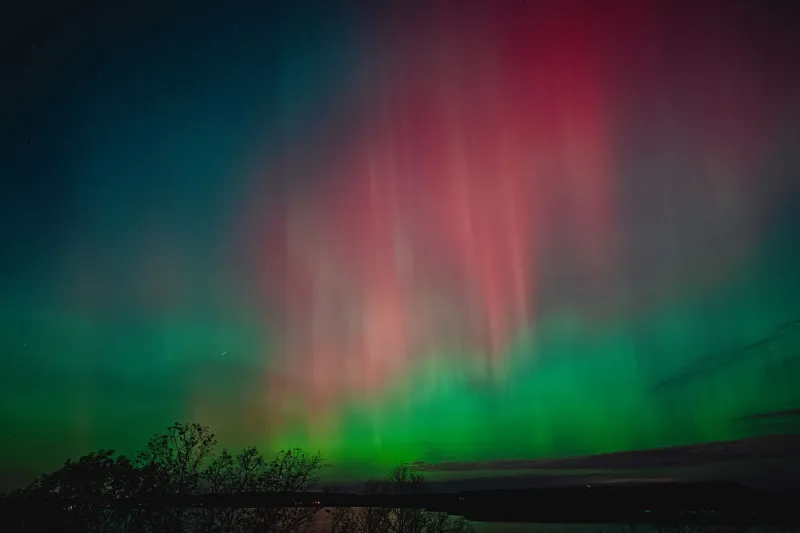
America offers an extraordinary range of atmospheric conditions, and each carries its own technical and emotional demands. The aurora borealis, visible on clear nights in Alaska and across the northern tier of states from Montana to Maine, requires a photographer to master long exposures in temperatures that routinely challenge equipment as much as endurance. The green and violet curtains of charged particles that dance above Fairbanks or the shores of Lake Superior do not wait for the camera to warm up.
Then there is the desert Southwest, where the light operates by entirely different rules. Photographers who work the canyon country of Utah and Arizona speak of a phenomenon locals call "canyon glow"—the moment after sunset when the sandstone walls continue to radiate absorbed heat as warm amber and rust, illuminating the canyon floor from all directions simultaneously. It is a quality of light that exists nowhere else in the country, and it lasts, on a good evening, perhaps twenty minutes.
The Mississippi River corridor produces its own spectacle. During late autumn and early winter, temperature differentials between the water and the surrounding air generate fog banks of extraordinary density and movement. Photographers who have worked the river between Memphis and St. Louis describe mornings when the fog rises in discrete columns, backlit by a sun still below the tree line, creating effects that resemble nothing so much as a landscape painting executed in real time.
What the Chase Demands
To photograph these phenomena well demands far more than technical proficiency, though technical proficiency is certainly required. Photographers who pursue specific light conditions across state lines speak consistently of a preparatory period that resembles athletic training more than artistic practice. They study historical weather data. They maintain relationships with meteorologists, park rangers, and local farmers who understand microclimatic patterns accumulated over generations. They arrive days early and leave days late, accepting that the phenomenon they seek may not appear during their window at all.
Eleanor Marsh, a fine art photographer based in Portland, Oregon, has spent eleven years documenting what she calls "transition light"—the specific quality of illumination that occurs during rapidly changing weather systems along the Pacific Coast and the Northern Rockies. She describes her process as fundamentally different from conventional location scouting. "Most photographers look for beautiful places," she has noted in interviews. "I'm looking for beautiful instability. I need the sky to be in argument with itself."
That instability carries genuine risk. Photographers pursuing severe weather phenomena—the electric skies of Tornado Alley, the sea-smoke conditions off the Maine coast in January, the dust storms that periodically transform the light above the Sonoran Desert into something amber and apocalyptic—operate in conditions that demand not only technical preparation but sound judgment about personal safety.
The Spiritual Dimension
What distinguishes the photographers who pursue America's most contested light from those who simply travel for their work is something harder to quantify than equipment lists or travel budgets. Multiple photographers who have spent years in this pursuit describe a relationship with their chosen phenomenon that has shifted over time from professional interest to something approaching reverence.
James Okafor, a documentary and fine art photographer who has spent eight years following the aurora across Alaska, northern Minnesota, and the Upper Peninsula of Michigan, speaks of the experience in terms that are explicitly spiritual. The aurora, he observes, cannot be commanded, cannot be scheduled, and cannot be replicated. "Every time I see it, I feel like I've been permitted to witness something," he has said. "Not invited. Permitted. There's a difference."
This sense of conditional access—of being granted a view rather than simply purchasing one—appears repeatedly in conversations with photographers who have built bodies of work around specific natural light conditions. It produces, over time, a quality of humility that manifests directly in their images. The photographs these artists make tend to share a certain quality of restraint, as though the photographer understood that their role was to record, not to interpret.
Technical Mastery in Service of the Unpredictable
For all its spiritual dimensions, the pursuit of America's most dramatic natural light is grounded in rigorous technical practice. Aurora photography demands an understanding of sensor sensitivity, noise management at extreme ISO settings, and the geometry of Earth's magnetic field. Canyon light photography requires a precise command of exposure bracketing and an intimate knowledge of how different sandstone formations absorb and release heat. River fog photography turns on the photographer's ability to read the relationship between water temperature, air temperature, and wind speed with enough accuracy to position themselves correctly before the fog either forms or dissipates.
The photographers who do this work well tend to be exceptionally skilled at what might be called anticipatory technical decision-making—configuring their equipment for conditions that do not yet exist, based on environmental cues that most observers would not notice. They are, in a meaningful sense, reading the landscape the way a musician reads a score: not for what it is, but for what it is about to become.
The Portfolio That Cannot Be Manufactured
The bodies of work that emerge from years of this kind of pursuit carry a quality that is immediately recognizable to experienced viewers. They are not pretty in the conventional sense. They are true in a way that is far more difficult to achieve. The light in these images is not the light of a well-managed shoot. It is the light of a specific place at a specific moment that the photographer earned through years of preparation, patience, and willingness to be wrong about when and whether it would appear.
In an era when visual content is produced in extraordinary volume and at extraordinary speed, there is something quietly radical about a body of work that can only be built slowly, across years and state lines and predawn mornings spent waiting in the cold for a sky to decide what it wants to do. These photographers are not chasing content. They are, in the fullest sense of the phrase, chasing light—and the best of their images make that distinction unmistakably clear.