Staying Long Enough to See: The Photographers Who Found America's Truest Stories on Small-Town Main Streets
Staying Long Enough to See: The Photographers Who Found America's Truest Stories on Small-Town Main Streets
There is a particular kind of light that falls through the plate-glass window of a small-town diner at seven in the morning — thin, unhurried, and indifferent to whether anyone is watching. It lands on coffee cups and laminate tabletops the same way it has for decades. It is not photogenic in the way that a canyon at golden hour is photogenic. It asks nothing of you, and it offers everything, provided you are willing to return to the same seat long enough to understand what you are looking at.
This is the light that a quiet but significant movement in American documentary photography has chosen to pursue. While the industry's collective gaze continues to drift toward coastal metropolises and wilderness expanses that photograph spectacularly on first encounter, a smaller cohort of practitioners has turned toward the towns that occupy the country's vast middle geography — communities of five thousand, twelve thousand, thirty thousand residents, where the visual story is not immediately obvious and where the camera must earn its access over time.
The Problem With the Overnight Visit
Conventional travel and editorial photography operates on compression. A photographer arrives, reads a location efficiently, identifies its most legible visual elements, and departs with images that confirm what an audience already expects to feel about a place. The resulting work is frequently accomplished and occasionally beautiful. It is rarely surprising.
Small-town America is particularly ill-served by this model. A single afternoon on a rural Main Street tends to produce a predictable inventory: a barbershop pole, a hand-lettered window sign, perhaps a weathered face framed against a pickup truck. These images are not false, but they are incomplete in a way that borders on distortion. They flatten the complexity of communities that have been navigating economic transition, demographic change, and cultural negotiation for generations — often simultaneously and without resolution.
The photographers who are generating the most compelling work from these environments have recognized that compression is the enemy of truth here. They have responded by doing the opposite: slowing down to a pace that most editorial assignments cannot accommodate and most photographers find professionally uncomfortable.
Presence as Methodology
Consider what changes when a photographer returns to the same hardware store every few weeks for two years. In the early visits, the owner is polite but guarded. The camera is tolerated. By the sixth or seventh visit, something shifts. The photographer becomes, in a modest way, a fixture — someone who belongs to the rhythm of the place. Conversations deepen. Invitations are extended. The camera begins to disappear into the background of ordinary transactions, and the images that result carry a quality of naturalness that no amount of technical skill can replicate on a first encounter.
This is not a new insight. The tradition of long-form documentary photography — from the Farm Security Administration projects of the 1930s to the sustained community work of photographers like Eugene Richards and Donna Ferrato — has always understood that time is not merely a logistical factor but a creative instrument. What is notable today is that a new generation of practitioners is applying this methodology specifically to the mid-sized American town, a subject that the documentary tradition has historically either romanticized or overlooked entirely.
What Main Street Actually Looks Like
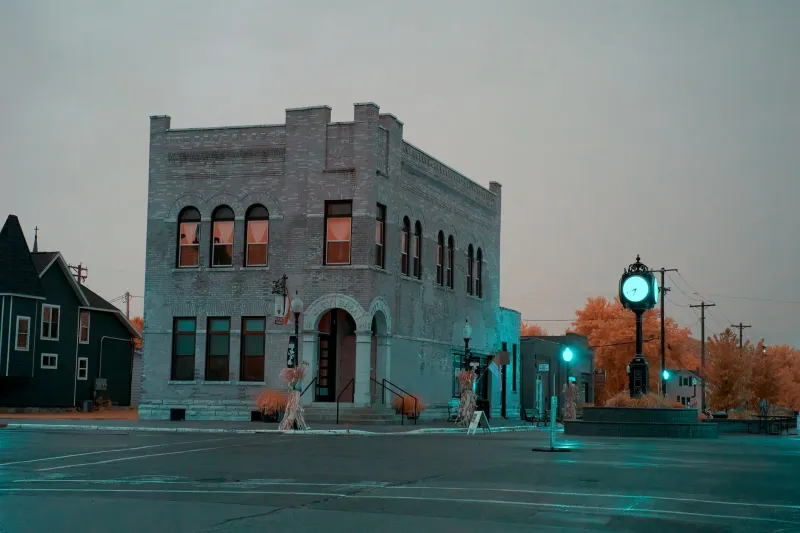
The visual texture of small-town commercial districts resists easy categorization. These are not the curated streetscapes of urban neighborhoods undergoing gentrification, nor are they the purely agrarian landscapes that appear in agricultural photography. They occupy an in-between register that is architecturally layered, economically complicated, and socially dense in ways that require patience to read.
A single block might contain a pharmacy that has operated under three generations of the same family, a vacant storefront that once housed a furniture retailer and now accumulates political signage, a recently opened coffee shop catering to remote workers who have relocated from larger cities, and a barbershop whose clientele has remained essentially unchanged for forty years. The relationships among these elements — the tensions, the accommodations, the quiet negotiations of who belongs and who is arriving — constitute a living document of American social history. The photographer who stays long enough begins to understand how these elements speak to one another across a single block.
Identity, Change, and the Longer Arc
What distinguishes the best of these long-form small-town projects is their willingness to hold contradiction without resolving it. The towns themselves are rarely simply declining or simply thriving. They are doing both, in different corners and at different speeds, and the photographic record that honors this complexity is necessarily one that accumulates over time rather than arriving at a single decisive image.
The diner that appears in year one of a project may close by year three. The building that housed it may reopen as something else, or remain dark. The family whose portrait anchored an early sequence may have dispersed, or deepened their roots. A photographer present across this arc does not merely document change — they document the experience of change as it is lived by people who do not have the option of moving on to the next assignment.
This is where these projects achieve something that glossy travel photography structurally cannot: they make visible the passage of time as a condition of American life rather than a backdrop to it.
The Question of Access and Ethics
Long-term community photography raises ethical questions that deserve serious attention. A photographer who spends years in a small town accumulates trust that carries obligations. The intimacy that makes these images powerful is also the intimacy that makes their subjects vulnerable. Practitioners working in this mode are increasingly thoughtful about consent, about how their subjects are represented, and about what happens to a community's self-image when an outside observer's interpretation achieves wider circulation than the community's own account of itself.
The most rigorous of these photographers maintain ongoing dialogue with their subjects throughout the editing and publication process — not surrendering creative authority, but acknowledging that the people in these frames have a legitimate stake in how their lives are presented to audiences who will never set foot in their town.
Where the Work Lives
The challenge for photographers committed to this kind of project is institutional. Long-form documentary work does not fit comfortably into editorial calendars or stock licensing models. It requires sustained funding, patient publishers, and audiences willing to engage with bodies of work rather than individual images.
Yet the appetite for this material appears to be growing. Independent photobook publishers, documentary film festivals with photography programming, and a handful of museum institutions have demonstrated genuine interest in multi-year community projects that resist the compression of conventional editorial formats. For photographers willing to accept the slower metabolism of this work, the creative rewards are considerable — and the contribution to the visual record of American life is, arguably, irreplaceable.
The country's Main Streets are not waiting to be discovered. They have been there, conducting their ordinary business, through every trend in photography that has come and gone. The question has always been whether the camera would stay long enough to see what they actually contain.