Darkroom Converts: The American Photographers Choosing Silence Over the Cloud
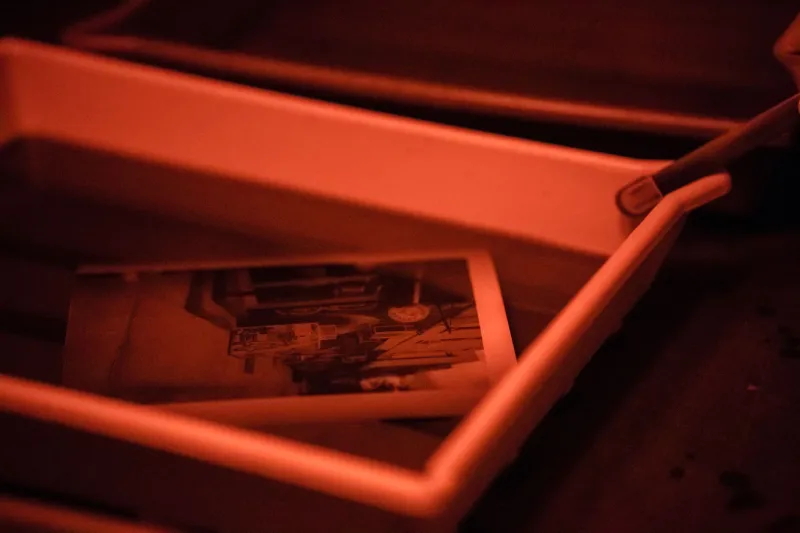
Somewhere in a converted basement in Asheville, North Carolina, a photographer named Daniel Pruett is standing in near-total darkness, watching an image emerge from a tray of developer solution. He cancelled his Adobe subscription fourteen months ago. His negatives live in archival sleeves in a fireproof cabinet. His client communications arrive by telephone or in person. He has no plans to return to digital workflow.
"The cloud never felt like mine," Pruett says. "The darkroom does."
Pruett is not an anomaly. Across the United States, a discernible countermovement is forming among photographers who are deliberately, methodically, and in many cases permanently walking away from the digital infrastructure that defines contemporary photographic practice. Their decision is not born of nostalgia alone. It reflects something more considered—a reckoning with what the convenience of digital workflow may have quietly cost them.
The Accumulation Problem
For many photographers who have made this transition, the breaking point was not a single dramatic event but a gradual accumulation of dissatisfaction. Hard drives multiplying beyond any reasonable cataloguing capacity. Terabytes of images that would never be printed, never be seen, never be meaningfully evaluated. The paradox of infinite storage producing creative paralysis rather than creative freedom.
Seattle-based photographer Amara Lindqvist describes opening her Lightroom catalog one morning and confronting 340,000 images accumulated over eight years of professional work. "I could not tell you what was in there," she says. "I had stopped editing intentionally. I was just archiving reflexively. The volume had completely overwhelmed any sense of curation."
That morning, Lindqvist began a transition that took eight months to complete. She now shoots exclusively on medium format film, develops her own negatives, and maintains a physical contact sheet archive organized by date and project. Her working catalog at any given time contains fewer than two hundred prints.
"I know every single image I have," she says. "That relationship with my own work didn't exist before."
What the Friction Produces
Photographers who have completed the transition to fully offline, analog workflows describe a consistent set of creative shifts—some expected, some genuinely surprising.
The most frequently cited is the recovery of intentionality at the moment of exposure. When each frame carries a measurable cost in film and chemistry, the calculation before pressing the shutter changes fundamentally. New York-based photographer Thomas Breckenridge, who spent twelve years as a commercial digital photographer before converting to an exclusively film-based practice, describes the shift as "learning to mean it."
"Digital had made me speculative," Breckenridge explains. "I would fire twenty frames and find the one that worked. Film forced me to find the one that would work before I fired it. That's a completely different cognitive process, and it changed my eye permanently."
The darkroom itself introduces a second layer of deliberateness. Unlike the instantaneous feedback of a monitor, the chemical development process demands patience and rewards careful prior judgment. Mistakes are not undone with a slider adjustment; they are studied, understood, and corrected in the next session. Several photographers in this movement describe the darkroom as a space for what one called "honest accounting"—a confrontation with the quality of one's seeing that digital post-processing can too easily defer.
Client Relationships Reimagined
For photographers who maintain professional practices alongside their personal work, the transition to analog workflow has necessitated significant renegotiation of client expectations—and produced some unexpected results.
Portrait photographer Cassandra Yuen, based in Austin, Texas, now offers exclusively film-based portrait sessions delivered as physical prints. Her turnaround time is longer than the industry standard. Her prices are higher. Her client waitlist currently extends four months.
"There is a segment of clients who deeply value the physical object," Yuen explains. "They are not interested in a digital gallery link. They want something they can hold, frame, and pass down. I had no idea how large that segment was until I stopped competing for everyone else."
Her experience suggests that the market for genuinely analog photographic work may be more substantial than the industry's digital consensus implies—a niche defined not by price sensitivity but by a desire for permanence and material authenticity.
The Archival Argument
Beyond creative and commercial considerations, several photographers in this movement cite archival durability as a significant factor in their decision. The fragility of digital storage—dependent on hardware that fails, software that becomes obsolete, and platforms that may not exist in twenty years—stands in unfavorable contrast to properly stored silver gelatin prints, which archivists conservatively estimate will remain stable for centuries.
Minneapolis-based photographer and educator Raymond Folse frames this in explicitly historical terms. "Every major photographic archive of the nineteenth and early twentieth centuries survives on physical media," he notes. "The photographic record of the last twenty years exists on formats that are already becoming inaccessible. The photographers who understand that are making different choices."
Folse now teaches darkroom practice at a community arts center, where enrollment in his introductory film photography course has tripled over three years. His students range from teenagers encountering analog process for the first time to mid-career professionals actively seeking the creative reset that only genuine friction can provide.
Not a Rejection, a Recalibration
It would be reductive to characterize this movement as simple technophobia or retrograde romanticism. The photographers involved are, almost universally, technically sophisticated practitioners who understand digital tools thoroughly and have chosen to set them aside for reasons they can articulate with precision.
What they describe, collectively, is a recalibration of the relationship between convenience and meaning—a recognition that the ease of digital workflow, whatever its genuine advantages, carries costs that are real even when they are invisible. In choosing the darkroom over the cloud, they are not abandoning the future. They are insisting that certain qualities of vision require resistance to produce.