Reading the Room Before the Moment Arrives: The Psychology of Anticipatory Photography
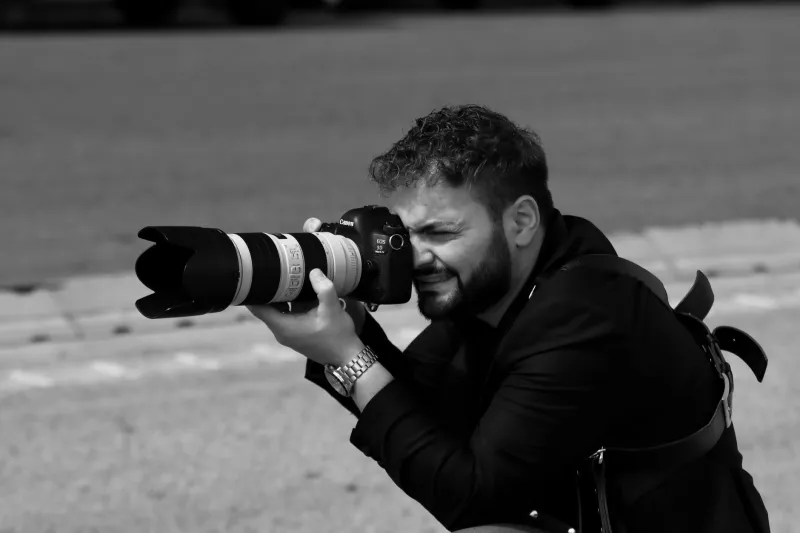
There is a particular kind of stillness that precedes extraordinary photography. Not the stillness of hesitation, but the composed, alert quiet of a mind that has already begun calculating what the next three seconds will produce. Among America's most accomplished working photographers, this capacity—to sense the frame before it fully assembles itself—represents perhaps the most difficult skill to teach and the most rewarding to acquire.
It is, in the truest sense, where light meets vision before either has fully declared itself.
The Myth of Pure Reaction
Conventional photographic wisdom celebrates the reactive eye: the shooter who instinctively raises the camera and fires at the precise instant the world arranges itself into meaning. That narrative, however romantic, omits the architecture of preparation that makes such moments possible.
San Francisco-based documentary photographer Renata Ochoa spent three years working alongside street performers in the Mission District before she began to understand what she describes as "the grammar of a scene." Every environment, she argues, communicates its intentions in advance. A crowd gathering at a corner, the angle of an approaching cyclist's shoulders, the precise way afternoon light tracks across a particular stretch of Market Street at 4:15 p.m.—these are not incidental details. They are sentences in a language that anticipatory photographers learn to read.
"Reaction is the beginner's tool," Ochoa explains. "Anticipation is what happens after you've been wrong enough times to finally start listening."
The Training Architecture
For photographers who have built careers on this skill, formal training occupies only a fraction of the developmental process. The more consequential education happens in deliberate, often unglamorous repetition.
Chicago-based photojournalist Marcus Delaney, whose work has appeared in regional and national publications for nearly two decades, describes a practice he calls "pre-visualization walks"—extended periods spent moving through a location without a camera, cataloguing light behavior, human traffic patterns, and architectural sightlines. When the camera eventually arrives, the environment is already partially mapped.
"You're not discovering the scene when you shoot it," Delaney says. "You've already had that conversation. The shooting session is just the confirmation."
This approach echoes disciplines far removed from photography. Competitive athletes, chess grandmasters, and emergency physicians all demonstrate what cognitive scientists term "pattern recognition under time pressure"—the ability to compress complex environmental data into near-instantaneous assessments. For photographers, the training mechanism is remarkably similar: volume, repetition, and deliberate post-session analysis of what was anticipated correctly and what was missed.
Equipment as a Cognitive Tool
The relationship between gear selection and anticipatory timing is subtler than most equipment discussions acknowledge. The choice of lens focal length, autofocus behavior, and even shutter actuation lag all interact with a photographer's anticipatory instincts in ways that either amplify or undermine them.
Portland, Oregon-based portrait and event photographer Sylvia Harmon made a counterintuitive discovery three years into her career: switching from a mirrorless system with near-zero shutter lag to a film camera with a manual advance mechanism actually sharpened her anticipatory timing rather than degrading it.
"When the equipment forces you to be deliberate, you stop gambling on reaction," Harmon explains. "You have no choice but to commit to the moment before it arrives. That discipline transferred back when I returned to digital."
Her observation points toward a broader principle that experienced photographers confirm repeatedly: the most sophisticated anticipatory timing is equipment-agnostic. It is a cognitive posture, not a technical specification.
Mental Frameworks That Produce Results
Several distinct mental models appear consistently among photographers who excel at anticipatory work.
The first is what New York-based street photographer Jerome Okafor calls "the second frame"—the practice of mentally composing not the image currently presenting itself, but the one that will exist two to four seconds later. By training his attention on the immediate future rather than the present, Okafor positions himself to capture peaks of action rather than their approaches.
A second framework involves deliberate emotional attunement. Dallas-based photographer Corinne Whitfield, who specializes in documentary work across Texas communities, describes spending significant time before a shoot simply observing social dynamics without photographic intent. The goal is not technical reconnaissance but emotional calibration—understanding the relational currents in a space well enough to sense when they are about to produce something visually significant.
"People telegraph their intentions constantly," Whitfield notes. "A conversation that's about to become an argument has a particular energy. A reunion that's about to become an embrace has its own signal. Learning to read those signals is not mystical. It's attentive."
The Patience Paradox
One of the more surprising findings among photographers who practice anticipatory timing professionally is that the skill tends to slow them down rather than accelerate them. Rather than firing more frames in pursuit of the decisive moment, many report making fewer exposures with higher rates of meaningful captures.
This paradox has practical implications for photographers seeking to develop their own anticipatory capacities. The instinct to increase frame rate in high-energy environments may actually work against the contemplative attention that anticipation requires. Slowing the trigger finger, counterintuitively, can open the perceptual bandwidth needed to read a scene's forward momentum.
For photographers at any stage of development, the discipline begins with a simple but demanding practice: arriving early, moving slowly, and listening to what the environment is already trying to say before the light assembles itself into the frame you came to find.