Beyond the Visible: How American Photographers Are Unlocking the Secret World of Infrared Light
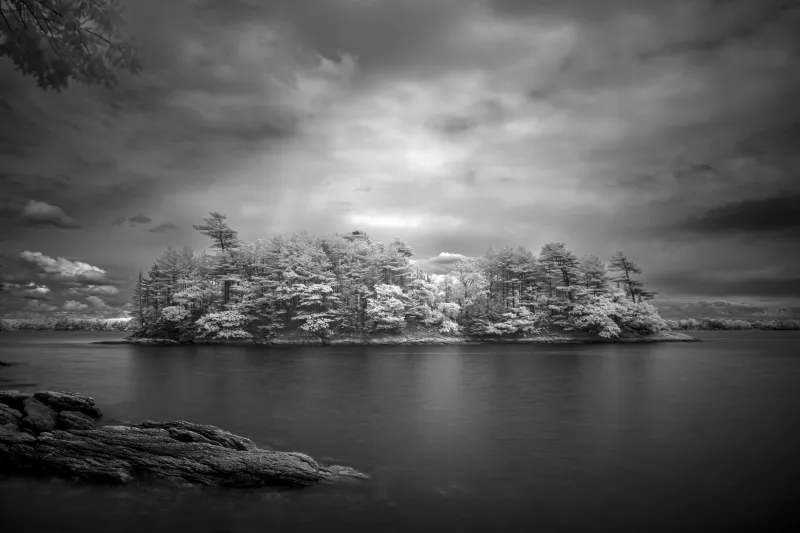
There is a version of the American landscape that no human eye has ever directly witnessed. Its foliage glows white as snow in midsummer. Its skies fall to near-black even at noon. Its water surfaces hold a luminous, almost mercurial stillness. This is the world as infrared light renders it — a parallel visual reality that exists just beyond the threshold of human perception, and one that a dedicated community of American photographers is now working to make permanently visible.
Infrared photography, once a niche concern of scientific imaging and aerial survey work, has evolved into one of the most creatively ambitious disciplines in contemporary American fine-art photography. As digital camera conversion technology has become more accessible and infrared-capable filters have improved in optical quality, practitioners across the country are turning their lenses toward the unseen spectrum with serious artistic intent.
What the Eye Refuses to See
The human eye perceives light within a relatively narrow band of the electromagnetic spectrum, roughly 380 to 700 nanometers in wavelength. Infrared radiation begins where visible red light ends, extending from approximately 700 nanometers upward. While our eyes are entirely blind to this range, camera sensors — particularly those that have been modified by removing or bypassing their built-in infrared-blocking filters — are capable of recording it with remarkable fidelity.
The results are visually dramatic in ways that no amount of post-processing in the visible spectrum can authentically replicate. Chlorophyll in living plant matter reflects infrared radiation with exceptional intensity, which is why healthy foliage appears luminously white or silvery in infrared images. Blue sky, by contrast, scatters very little infrared light and records as profoundly dark, often approaching pure black. Human skin takes on a porcelain-like quality. Water appears glassy and almost metallic. Architecture, stone, and pavement render with an unfamiliar tonal weight that strips familiar scenes of their visual comfort.
The effect, in the hands of a skilled photographer, is not mere novelty. It is a genuine reimagining of known spaces.
The Technical Foundation
Achieving consistent, high-quality infrared images requires one of two primary approaches: using a dedicated infrared-converted camera body or mounting a dense infrared-pass filter — such as those in the 720nm, 850nm, or 950nm ranges — over the lens of a standard camera.
Camera conversion, offered by specialized services throughout the United States, involves permanently removing the sensor's built-in infrared-cut filter and replacing it with a filter that passes only infrared wavelengths. The resulting camera is dedicated exclusively to infrared work but offers the considerable advantage of usable autofocus, manageable exposure times, and a live view that reflects actual infrared rendering. Many serious infrared practitioners in the American fine-art community maintain a converted body specifically for this purpose, often repurposing older camera models that remain optically excellent but have been superseded by newer technology.
The filter approach, while more economical, introduces significant complications. Dense infrared filters block nearly all visible light, rendering standard autofocus unreliable and requiring exposures that can extend to several seconds even in bright midday sun. Focusing must typically be accomplished before the filter is mounted, and the photographer must account for the slight focus shift that occurs between visible and infrared wavelengths — a consideration that varies by lens and requires careful testing.
Both methods demand a thorough understanding of white balance management. Because infrared images record color information in ways that bear no resemblance to visible-light photography, custom white balance settings — typically calibrated against green grass or foliage in the field — are essential to achieving images that respond predictably to post-processing.
Landscapes Transformed
American photographers working in the infrared medium have found that certain environments respond to the technique with particular power. Deciduous forests in the eastern United States — from the Appalachian highlands of North Carolina to the hardwood bottomlands of the Mississippi Delta — offer dense concentrations of chlorophyll-rich foliage that renders in infrared as almost incandescent. The visual contrast between glowing canopy and darkened sky produces images of an almost mythological quality, as though the landscape exists in a time outside of ordinary experience.
Open grasslands and prairie environments present a different but equally compelling set of possibilities. The vast wheat fields of Kansas, the tallgrass prairies of Oklahoma, and the meadow systems of the northern Rockies all respond to infrared light with a sweeping, tonal grandeur that conventional photography struggles to match. The luminosity of living grass against a darkened horizon creates a sense of spatial drama that photographers working in the visible spectrum must work considerably harder to achieve.
Urban environments, perhaps counterintuitively, have also become a productive territory for infrared work. Street trees, park plantings, and even the modest lawns of residential neighborhoods introduce organic infrared-reflective elements into architectural compositions. The result is an urban imagery that feels simultaneously familiar and profoundly estranged — the known city rendered strange by the intrusion of an invisible light.
The Creative Discipline Behind the Technique
What distinguishes the most compelling infrared work produced by American photographers is not the technique itself but the quality of vision that directs it. Infrared photography, for all its dramatic inherent characteristics, is not self-executing. Without strong compositional thinking, deliberate subject selection, and a clear understanding of how specific conditions — time of day, season, weather, and the particular species of vegetation present — will influence the final image, the results can feel arbitrary or merely decorative.
The most thoughtful practitioners approach infrared work with the same preparatory rigor they would bring to any demanding photographic discipline. They scout locations in advance, often visiting during conventional light to assess compositional potential before returning with infrared equipment. They study seasonal foliage cycles, recognizing that the infrared response of deciduous trees changes substantially as the growing season progresses. They remain attentive to atmospheric conditions, understanding that haze, humidity, and cloud cover all influence how infrared radiation moves through the environment.
Many also engage deeply with the post-processing phase of their work, developing personal approaches to tonal management and, in the case of false-color infrared — where the camera records both infrared and residual visible light — channel-mixing techniques that allow for highly individualized color interpretations. The false-color infrared palette, which can range from warm golden tones to vivid magenta and cyan combinations, has become a distinctive visual language in its own right within American fine-art photography.
A New Dimension of Vision
At its most ambitious, infrared photography invites both the photographer and the viewer into a sustained renegotiation of what it means to see. The familiar world — the park, the forest path, the city block — is not replaced but revealed in a new register, one that speaks to dimensions of light and life that ordinary perception cannot access.
For the photographers committed to this work, that revelation carries a significance that extends well beyond technical accomplishment. It is a reminder that the world contains more than the eye can hold, and that the camera, properly equipped and thoughtfully directed, remains one of the most powerful instruments we possess for expanding the boundaries of human vision.
In this sense, infrared photography is not simply a technique. It is a practice of attention — a commitment to looking past the surface of the visible world toward something deeper, stranger, and altogether more luminous.