Miles of Vision: Ten Overlooked American Highways Where the Road Itself Becomes the Portfolio
The Road as a Living Frame
America's most celebrated scenic routes attract crowds for good reason. Yet the photographers who return year after year with the most arresting images often bypass the obvious corridors entirely. They seek out the forgotten two-lane highways, the mist-shrouded mountain backroads, and the sun-bleached desert cuts that appear on few tourist itineraries but reward the patient, deliberate image-maker with compositions that feel genuinely discovered rather than inherited.
What follows is a curated selection of ten underrated American highways — each one a distinct visual environment, each one capable of sustaining an entire photographic project. Whether you are planning your first long-distance road trip with a camera or refining an ongoing body of work, these corridors offer something the algorithm cannot replicate: the sensation of light meeting landscape in real time, mile by unpredictable mile.
1. U.S. Route 50 — Nevada's Loneliest Road
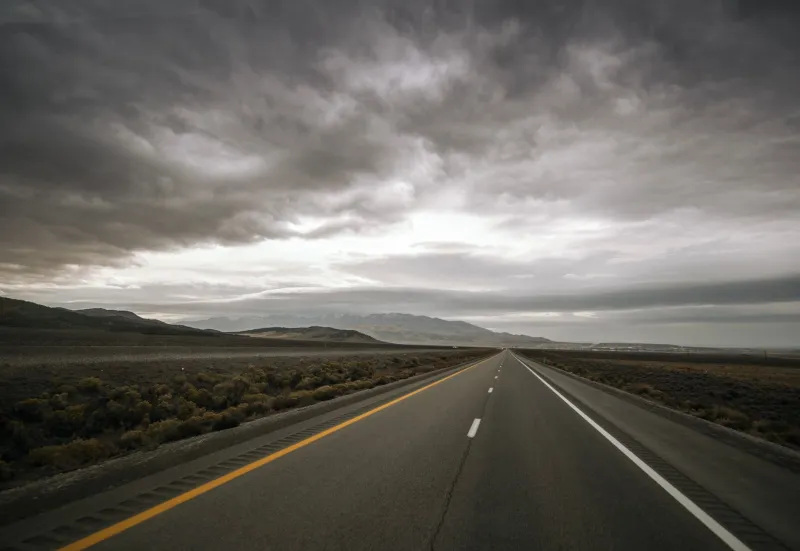
Designated the "loneliest road in America" by Life magazine in 1986, U.S. Route 50 across Nevada stretches nearly 400 miles through a landscape so spare it borders on abstraction. Photographers who have worked this corridor describe it as a study in negative space — vast alkali flats, isolated mountain ranges, and a sky that functions as a second subject rather than a background. The absence of visual clutter makes compositional decisions unusually deliberate. Early morning light rakes across the desert floor with cinematic precision, and the occasional gas station or weathered motel sign reads as a profound human gesture against the emptiness.
Best season: Late spring and early fall, when temperatures are manageable and afternoon thunderstorms build dramatic cloudscapes.
2. The Natchez Trace Parkway — Mississippi to Tennessee
Running 444 miles from Natchez, Mississippi, to Nashville, Tennessee, the Natchez Trace Parkway is federally protected, which means no commercial signage, no billboards, and no visual interruption. For the landscape photographer, this translates to an almost meditative shooting environment. Tupelo gum trees arch over the roadway in autumn, creating natural tunnels of amber and gold. Historian-photographer Margaret Elaine Forsyth, who spent three consecutive autumns documenting the Trace, describes it as "the closest thing to a controlled studio environment I have ever encountered outdoors."
Best season: Mid-October through early November for foliage; late March for dogwood blooms.
3. Highway 12 — Utah's Red Rock Corridor
Running through the heart of southern Utah's canyon country, Highway 12 is occasionally acknowledged by travel publications, yet remains dramatically underutilized by serious photographers relative to its visual density. The highway crests the spine of the Hogback Ridge — a narrow ridge with canyon drop-offs on both sides — and descends through Bryce Canyon's pink limestone hoodoos, Grand Staircase-Escalante's labyrinthine slot canyons, and Boulder Mountain's alpine meadows, all within a single driving day. The tonal range available to the photographer here, from the deep burgundy of Navajo sandstone to the pale sage of high-elevation grasslands, is extraordinary.
Best season: May and September offer the most balanced light-to-crowd ratios.
4. The Blue Ridge Parkway's Southern Reaches — North Carolina
While the Blue Ridge Parkway is broadly known, its southern terminus near Cherokee, North Carolina, receives a fraction of the foot traffic that clusters around Asheville and the Virginia sections. This lower stretch rewards the photographer with intimate Appalachian hollows, wildflower meadows, and fog behavior that is unlike anywhere else in the eastern United States. Morning mist pools in the valleys below the ridge, creating layered compositions that recall the tonal subtlety of ink-wash painting. Photographer Daniel Croft has spent seven consecutive winters along this stretch, producing a body of work he describes as "portraits of weather rather than portraits of place."
Best season: Late October for color; late February for frost and bare-branch minimalism.
5. U.S. Route 89 — Montana to Arizona
Running nearly the full north-south length of the American West, U.S. Route 89 passes through environments so varied they seem to belong to different continents. From Glacier National Park's glacially carved valleys in Montana, through Wyoming's high sage flats, into the canyon country of Utah, and finally into the red-rock gateway of northern Arizona, this highway functions as a visual autobiography of the Western landscape. No single photographer has documented the full corridor, which presents an open invitation for a multi-year project of genuine scope.
Best season: Varies dramatically by section; plan segment by segment.
6. The Forgotten Stretches of Route 66 — Oklahoma and Texas
Much of Route 66's photographic attention concentrates on California's Mojave section or Arizona's painted desert. Yet the Oklahoma and Texas panhandle stretches — particularly the ghost towns between Shamrock and Amarillo — offer a rawer, less curated visual environment. Rusted grain elevators, abandoned motor courts, and hand-painted roadside signage carry a documentary weight that the more-photographed western sections have partly lost to over-familiarity. The light in the Texas panhandle, particularly in late afternoon, is a warm, low-angle gold that transforms even mundane architecture into something luminous.
Best season: October and March, avoiding summer heat and winter ice.
7. Highway 1 Through the Lost Coast — Northern California
California's Highway 1 is famous for its Big Sur section, but the highway's northern reach — particularly the approaches to the King Range National Conservation Area — remains comparatively quiet. The Lost Coast's combination of coastal fog, old-growth redwood silhouettes, and black-sand beaches produces a visual palette that is simultaneously moody and majestic. The absence of reliable cell service here is, for many photographers, a liberation rather than an inconvenience.
Best season: Late summer, when fog lifts by midday; winter for dramatic storm light.
8. U.S. Route 191 — Wyoming's Back Channel
Paralleling the more-traveled approaches to Yellowstone, U.S. Route 191 through the Wind River Range and Bridger-Teton National Forest offers wildlife encounter frequency that rivals the park itself, with a fraction of the traffic. Bison, pronghorn, and moose are regular roadside presences, and the quality of evening light against the Wind River peaks is among the finest in the American West.
Best season: September, during elk rut and early snow on the peaks.
9. The Turquoise Trail — New Mexico
Running between Albuquerque and Santa Fe through the Sandia and Ortiz Mountains, the Turquoise Trail (State Road 14) passes through a succession of former mining towns — Madrid, Cerrillos, Golden — that have calcified beautifully into something between a living community and an open-air museum. Adobe walls, hand-lettered signs, and the particular quality of high-desert light at altitude give the corridor a palette that shifts from terracotta at midday to deep violet at dusk.
Best season: Year-round, with winter snow adding a striking contrast to the warm-toned adobe.
10. U.S. Route 2 — The Northern Tier
Running from Maine to Washington State, U.S. Route 2 is the northernmost transcontinental highway and one of the most visually underrepresented corridors in American photography. Its eastern sections traverse the Connecticut River valley and the White Mountains of New Hampshire; its central stretches cross the vast wheat and canola fields of North Dakota; its western terminus cuts through the Cascades. The sheer tonal variety available across its full length makes it a lifetime project rather than a single trip.
Best season: Mid-September through mid-October for the eastern sections; June for the northern plains.
Practical Considerations for the Highway Photographer
Regardless of which corridor you choose, several principles apply universally. Scout digitally before you drive physically — satellite imagery and topographic maps can identify promising viewpoints before you commit a day of driving. Travel light but deliberately — a single zoom lens covering a moderate wide-to-short telephoto range handles the majority of highway shooting scenarios without the weight penalty of a full kit. Respect the shoulder — pulling safely off the road is not only a legal obligation but a compositional one; rushed shots from a moving vehicle rarely produce the images that a properly positioned, stationary frame can deliver.
Finally, resist the impulse to cover maximum distance. The photographers who produce the most compelling highway work almost always cite a counterintuitive discipline: they drive less than they planned. A single mile, revisited across different hours of a single day, can yield more visual material than a hundred miles covered at speed. The road, at its finest, is not a route to a destination. It is the destination itself.