Between Two Worlds: Discovering America's Most Compelling Stories at the Threshold
Between Two Worlds: Discovering America's Most Compelling Stories at the Threshold
There is a particular kind of stillness that settles over a front porch in the late afternoon. A rocking chair holds the impression of someone who was just there. A screen door rests slightly ajar. A pair of boots sits beside a welcome mat worn thin by years of use. Nothing dramatic is happening — and yet, for the photographer who understands what they are looking at, everything is happening.
America's thresholds — its porches, storefronts, entryways, and doorsteps — constitute one of the most underexplored visual territories in contemporary photography. These are the spaces where private life meets public witness, where architecture becomes autobiography, and where the camera, if positioned with patience and intention, can capture something genuinely irreplaceable.
The Liminal Zone as a Narrative Device
In literary theory, a liminal space is defined as a transitional state between what was and what is yet to come. Photography has its own version of this concept, and it lives at the threshold. The moment a subject stands in a doorway — half inside, half out — they exist in a kind of suspended story. The image does not resolve neatly. It asks the viewer to lean in.
This ambiguity is precisely what makes threshold photography so powerful. Unlike an interior portrait, which places a subject fully within their world, or a street photograph, which captures them entirely in the public domain, a threshold image holds both realities in tension. The result is a visual complexity that rewards extended looking.
Consider the tradition of American documentary photography. Some of the most enduring images from the Farm Security Administration's Depression-era archives were made not inside homes or in open fields, but at the exact point of intersection — families gathered at doorframes, sharecroppers leaning against porch columns, children peering through broken screen doors. The threshold was never incidental. It was the point.
Reading the Porch: The South, the Midwest, and Beyond
No architectural feature is more distinctly American, or more photographically generous, than the front porch. In the American South, the porch functions as an extension of domestic life — a semi-public room where conversations unfold over hours, where neighbors are received, and where the day is watched as it passes. Photographically, these spaces offer extraordinary layering: the interior dark behind a subject, the bright exterior light illuminating their face, and the porch itself serving as a kind of stage.
In the American Midwest, the porch takes on a different character — often more formal, more symmetrical, occasionally more guarded. In cities like Cincinnati, St. Louis, and Indianapolis, the front porch of a century-old bungalow carries the weight of immigrant history, working-class pride, and neighborhood continuity. The details matter enormously here: a flag bracket, a potted geranium, a storm door replaced sometime in the 1970s and never updated since.
For photographers working in these regions, the most effective approach is one of deliberate slowness. Walk the block before you raise the camera. Identify which porches carry visual narrative — not necessarily the most dramatic or the most decorated, but the ones where time has left the clearest mark. Then return at the right light.
Storefronts as Self-Portraits
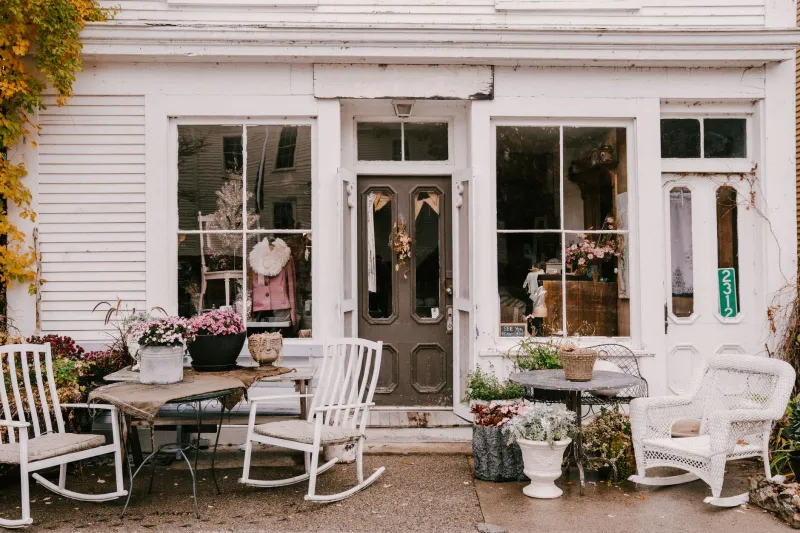
If the residential porch is where private life opens cautiously toward the street, the commercial storefront is where ambition, identity, and community intersect at eye level. America's independent storefronts — the barbershops of Harlem, the taquerias of East Los Angeles, the record stores of Portland, the bait shops of coastal Louisiana — are among the richest visual documents the country produces.
What makes a storefront compelling to photograph is rarely the merchandise visible through the glass. It is the accumulated evidence of a business's relationship with its neighborhood: hand-lettered signs layered over older hand-lettered signs, a string of lights installed for one holiday season that never came down, a front door painted a color that once matched something now long gone.
In Chicago, the storefronts of neighborhoods like Pilsen and Bridgeport tell stories of cultural succession — murals from one era painted beside signage in a different language, the visual record of who came, who stayed, and who is arriving now. Photographing these spaces requires sensitivity and, often, conversation. The best images of storefronts tend to emerge after the photographer has spoken with the person who unlocks the door each morning.
Technically, storefront photography benefits from an awareness of reflections. The glass of a shop window does not simply reveal the interior — it also captures the street behind the photographer, creating an involuntary double exposure of inside and outside that can be extraordinarily evocative when composed with care.
Technique: Positioning Yourself at the Edge
The practical challenge of threshold photography is one of position and patience. Unlike landscape work, where the photographer controls their relationship to the subject entirely, or studio portraiture, where every variable is managed, threshold work requires a willingness to wait and to accept the conditions as they arrive.
Several principles tend to produce the strongest results:
Work the light from the outside in. In most threshold situations, the exterior is brighter than the interior. This natural contrast creates depth and drama. Position yourself so that the light source — whether morning sun, overcast sky, or streetlight — falls across the threshold rather than directly into the frame.
Use a moderate focal length. Wide-angle lenses can distort the intimate geometry of a porch or doorway in ways that feel unflattering. A 35mm or 50mm lens on a full-frame body tends to render these spaces with a truthfulness that matches how the eye actually experiences them.
Include the threshold itself as a compositional element. The doorframe, the step, the edge of the porch railing — these are not obstacles to work around. They are the subject's context and, used deliberately, they become natural framing devices that direct the viewer's eye toward the human presence within.
Return more than once. A porch at noon looks nothing like the same porch at seven in the evening. A storefront before it opens tells a different story than one photographed as the last customer leaves. The threshold rewards revisitation.
Why This Space Matters Now
At a moment when so much American life has migrated inward — to screens, to private spaces, to curated digital interiors — the physical threshold carries renewed significance. It is still the place where neighbors acknowledge each other, where communities assert their presence, where the private self steps out to meet the world.
For photographers committed to documenting American life with honesty and depth, these spaces offer something that neither the interior nor the open street can provide alone: the moment of crossing. The pause before the door opens or closes. The face caught between two worlds.
That pause is where the most honest images live. And it is waiting, right at the edge, for the photographer willing to stop and look.