Grain and Gigabytes: How American Photographers Are Forging a New Creative Language Between Film and Digital
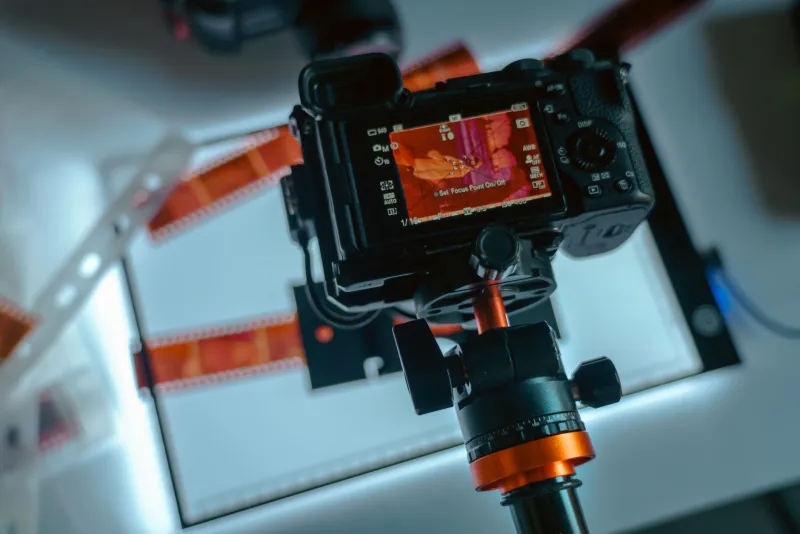
There is a particular quality to a photograph made on film — an organic unpredictability, a luminous depth in the shadows, a grain structure that breathes rather than simply renders. Yet film alone cannot offer the immediate feedback, the dynamic range control, or the post-processing flexibility that modern digital capture delivers. A growing cohort of American photographers has decided they need not choose between these two worlds. Instead, they are building something new at the intersection of both.
This is not a story about nostalgia. It is a story about creative evolution.
The Hybrid Aesthetic Defined
At its core, the film-digital hybrid workflow takes many forms. Some photographers shoot exclusively on medium-format film, then scan their negatives at high resolution and finish the images in Adobe Lightroom or Capture One. Others reverse the sequence — capturing digitally in RAW format, then printing onto transparency film before exposing cyanotype or platinum-palladium prints in their home darkrooms. Still others blend the two at the capture stage itself, using a film camera alongside a digital body during a single shoot and merging elements of both in post-production.
What unifies these approaches is intention. The photographers adopting this methodology are not stumbling into analog processes by accident. They are making deliberate creative decisions about where each medium contributes most powerfully to the final image.
Portrait Work: Finding Soul in the Silver
New York-based portrait photographer Elena Vasquez has built a reputation for intimate editorial work that appears in regional lifestyle publications across the Northeast. For the past three years, she has been shooting all of her personal portrait projects on 120mm medium-format film — specifically Kodak Portra 400 — before scanning the negatives and completing color grading digitally.
"Digital gives me perfect sharpness, perfect exposure control. But when I put a roll of Portra through my Hasselblad, something happens to skin tones that I simply cannot replicate in post-processing, no matter how skilled I am," Vasquez explains. "The film does something to the interaction between highlight and shadow on a human face that feels genuinely three-dimensional. Then I bring that scan into Lightroom and I have complete control over the final presentation. I get both things."
For Vasquez, the scanning process is itself an art form. She uses a dedicated drum scanner to extract maximum tonal information from her negatives, treating the digital file not as a replacement for the analog original but as a faithful translation of it. The resulting portraits carry a quality her clients consistently describe as "timeless" — a word that speaks directly to the hybrid aesthetic's power.
Landscape Photography: Precision Meets Poetry
In the American Southwest, landscape photographer Marcus Webb has developed a workflow that many of his peers consider unusually rigorous. Webb shoots digitally in the field — typically with a full-frame mirrorless camera — to capture precise exposures and bracket his dynamic range across the extreme contrasts of desert light. Back in his Tucson studio, he selects his strongest digital frames, then works with those files to produce large-format inkjet negatives, which he exposes onto hand-coated silver gelatin paper.
"The digital capture gives me technical accuracy I could never achieve in the field with a large-format film camera," Webb says. "The terrain I work in doesn't always allow for a slow, methodical setup. But I want the final print to have the physical presence of a traditional darkroom photograph. The hybrid process lets me have both the precision of digital and the materiality of analog."
Webb's prints — some measuring four feet across — have been exhibited at galleries in Santa Fe and Scottsdale. Critics have noted that his images possess a quality rarely seen in purely digital landscape work: a sense that the photograph has a physical relationship with the landscape it depicts, rather than merely documenting it from a distance.
Street Photography: Embracing Uncertainty
Chicago-based street photographer Dana Okafor works in a more spontaneous register than either Vasquez or Webb, yet she has arrived at her own version of the hybrid approach. Okafor shoots street work on a 35mm film camera — often Ilford HP5 pushed to 1600 ISO for high-contrast black-and-white results — and scans the negatives herself using a flatbed scanner. She then completes a minimal digital edit focused primarily on contrast and tonal range before preparing files for exhibition printing.
"Street photography is about being invisible and being fast," Okafor notes. "A small film camera helps me with both. But the scanning workflow means I can share work online immediately after a shoot, get feedback from my community, and make decisions about sequencing and editing with the same tools any digital photographer uses. I'm not sacrificing the contemporary conversation to work with film."
Okafor's approach highlights one of the hybrid workflow's most practical advantages: analog capture does not require analog distribution. Scanned film images move through the same digital pipelines as any other contemporary photograph, reaching audiences on social media, in digital publications, and in print portfolios without friction.
The Technical Case for Hybridization
Beyond the aesthetic arguments, there is a compelling technical rationale for blending these two photographic traditions. Film, particularly medium and large format, captures tonal gradations in a way that many photographers describe as more forgiving in the highlights — a quality that translates beautifully when scanned and processed digitally. Digital sensors, meanwhile, offer extraordinary low-light performance, precise color accuracy, and the ability to shoot thousands of frames without the cost constraints that film imposes.
Modern scanning technology has also dramatically lowered the barrier to entry. Devices such as the Plustek OpticFilm series and the Epson Perfection V850 Pro allow photographers to digitize their film at resolutions sufficient for large exhibition prints, without the expense of professional drum scanning for every project. Combined with increasingly sophisticated grain-simulation tools in software like Capture One and DxO FilmPack, the line between an authentically hybrid image and a purely digital one processed to resemble film has grown genuinely porous.
This porousness is itself instructive. It suggests that what photographers are ultimately chasing is not a specific medium but a specific quality of vision — one that the hybrid approach delivers more reliably than either tradition alone.
A Forward-Looking Tradition
At Clor Images, we believe that great photography has always been defined by the deliberate choices photographers make about how light is gathered, translated, and presented. The film-digital hybrid movement is simply the latest expression of that principle — a recognition that the tools of the past and the tools of the present are not opponents but collaborators.
American photographers who have embraced this approach are not retreating from modernity. They are expanding its vocabulary, adding texture, depth, and material richness to a visual culture that sometimes risks becoming too frictionless, too immediate, too clean. In the grain of a properly exposed negative, in the chemistry of a well-made scan, there is a reminder that photography has always been, at its heart, a conversation between light and intention.
That conversation, it turns out, sounds richer when conducted in two languages at once.