Double Exposure of Meaning: How America's Most Thoughtful Photographers Have Learned to Read a Reflection
Double Exposure of Meaning: How America's Most Thoughtful Photographers Have Learned to Read a Reflection
There is a particular kind of photograph that announces itself too loudly. The subject gazes into a mirror, their reflected face occupying the frame alongside their turned back, and the viewer is meant to feel something profound about duality or self-perception. Sometimes it works. More often, it does not. The technique has become so reflexively employed — so casually reached for when a photographer senses that an image needs additional dimension — that the reflective surface has developed a reputation it does not entirely deserve.
The problem is not the mirror or the window. The problem is the assumption that the reflection does the work on its own.
A Surface That Demands More Than It Offers
Photographers who have spent serious time working with reflective surfaces tend to describe the same early realization: a reflection does not automatically confer meaning. It creates the conditions for meaning, but those conditions must be fulfilled through deliberate compositional thought, precise timing, and an understanding of what the reflection is actually saying about the primary subject.
New York-based documentary photographer Elaine Sorrell has spent years photographing urban storefronts, frequently incorporating window glass as a compositional element. Her approach is instructive. "The window is never the point," she has explained in interviews. "What matters is the relationship between what's inside the glass and what's being reflected from the street. When those two worlds speak to each other, you have something. When they don't, you just have a window."
That relationship — the dialogue between the world behind the glass and the world in front of it — is where the technique's genuine power resides. A clothing boutique window reflecting a shuttered factory across the street says something about economic change that neither image could convey alone. A bathroom mirror capturing both a person's present face and a faded family photograph on the wall behind them creates a temporal compression that straightforward portraiture rarely achieves.
The Technical Demands Nobody Warns You About
Beyond the conceptual challenges, reflective surfaces present formidable technical obstacles that frequently trip up photographers who underestimate them.
Exposure management ranks among the most persistent difficulties. Glass and mirrors rarely reflect light at the same intensity as the scene surrounding them. A photographer shooting a subject near a window in late afternoon must contend with a reflected exterior that may be several stops brighter than the interior space. Bracketing exposures and committing to selective processing in post is one solution; positioning and timing to work with rather than against the available light is generally the more elegant approach.
Polarizing filters offer significant assistance with window reflections, allowing the photographer to dial down or eliminate surface glare depending on the shooting angle. However, the complete removal of reflection is not always desirable. Many of the most compelling window photographs derive their power precisely from the tension between transparency and reflectivity — the partial ghost of the street layered over the scene within. Learning to modulate rather than eliminate reflection is a skill that develops slowly and rewards patience.
Focus presents its own complications. A camera's autofocus system, confronted with a reflective surface, frequently hesitates between the glass itself, the subject behind it, and the reflected scene in front of it. Manual focus, or at minimum a thorough understanding of how to lock focus on the intended plane, is essentially non-negotiable when shooting through or at reflective surfaces.
Mirrors as Psychological Instruments
If windows tend to function as metaphors for boundary and threshold — the inside looking out, the outside pressing in — mirrors operate on a more intimate psychological frequency. They invoke self-examination, vanity, memory, and the unsettling question of whether the image we see of ourselves corresponds to anything real.
Portrait photographer Marcus Webb, working primarily in Chicago and Detroit, has built a significant body of work around mirrors placed within domestic spaces. His subjects are photographed not directly but through their reflections, a choice that initially seems merely stylistic but accumulates considerable psychological resonance across a series. "When someone looks into a mirror, they're performing," Webb has noted. "Even alone, they're constructing a version of themselves. I'm photographing that performance, not the person underneath it. Sometimes those are the same thing. Often they're not."
This distinction — between the person and the person's self-presentation — is one that direct portraiture can suggest but rarely captures as precisely as mirror work executed with intention. The reflection becomes a document of self-conception rather than simply appearance.
When the Technique Becomes a Crutch
The cautionary dimension of reflective surface photography deserves equal attention. Social media platforms have generated an enormous volume of mirror and window photography in recent years, much of it technically competent and conceptually hollow. The reflection has become shorthand for depth, a visual signal that the photographer is doing something more sophisticated than a straightforward shot — without necessarily being true.
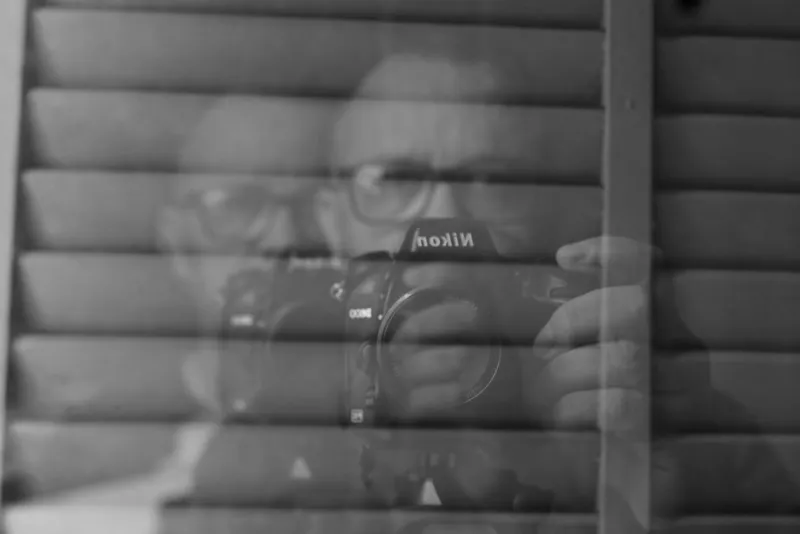
The warning signs are recognizable. A reflection employed purely for symmetry, with no meaningful relationship between the reflected world and the primary scene. A mirror used to place the photographer within the frame as a signature rather than a compositional choice. Window glass deployed to add atmospheric haze to an image that lacks underlying substance. These applications are not failures of technique; they are failures of intention.
The standard worth holding oneself to is straightforward: if the reflection were removed from the image, would the remaining photograph still communicate something worth communicating? If the answer is yes, the reflection is an addition. If the answer is no, the reflection may be a substitution — a visual complexity standing in for conceptual clarity.
Learning to Look Through Both Planes
The photographers who use reflective surfaces most effectively tend to share a particular habit of perception. Before raising the camera, they spend time simply looking — not at the subject, not at the reflection, but at both simultaneously, allowing the eye to move between planes until a relationship becomes visible.
This is, in a sense, the fundamental discipline that reflective surface photography demands and rewards. It trains the photographer to see the frame as a layered space rather than a flat one, to recognize that every image contains depths and surfaces, foregrounds and backgrounds, the explicit and the implied. A mirror or a window, properly understood, is not a trick. It is an invitation to see more carefully than the scene initially seems to require.
At Clor Images, we return repeatedly to this principle: the most powerful photographs are not those that show the most, but those that reveal the most. Reflective surfaces, approached with rigor and genuine intention, remain among the most sophisticated tools available for that kind of revelation.