Into the Vortex: The American Photographers Who Make Catastrophe Their Canvas
There is a particular kind of stillness that precedes a tornado — a greenish cast to the sky, an unnatural silence where birdsong once filled the air, and a barometric pressure drop that experienced observers describe as something felt in the chest before it is registered by the mind. For most Americans, that stillness is a signal to seek shelter immediately. For a small and fiercely dedicated community of weather photographers, it is an invitation to raise the camera.
These individuals occupy a singular position within the broader landscape of American photography. They are not war correspondents, though the dangers they face are comparably serious. They are not wildlife photographers, though their subjects are equally unpredictable. They are storm chasers with cameras — practitioners of a discipline that demands meteorological expertise, mechanical precision, split-second spatial reasoning, and an appetite for beauty that refuses to recognize the boundary between the sublime and the dangerous.
The Geography of Pursuit
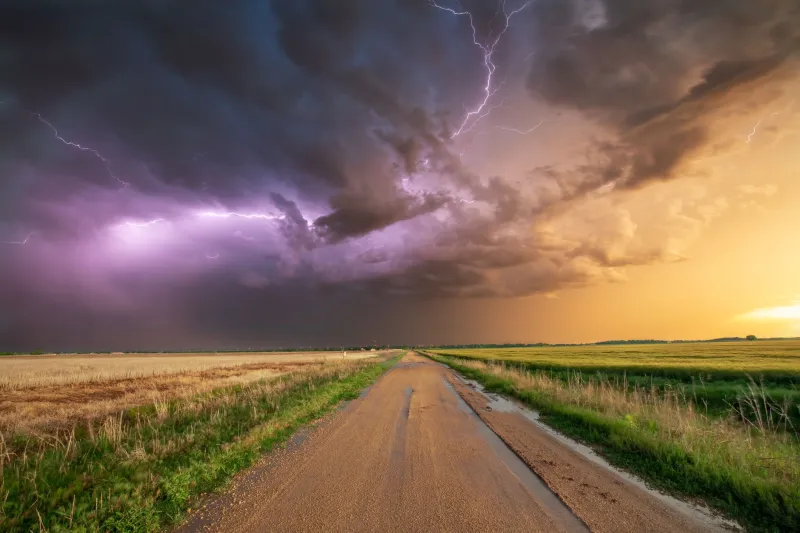
The American Great Plains constitute the world's most productive theater for severe weather photography. Stretching from northern Texas through Oklahoma, Kansas, Nebraska, and into the Dakotas, this corridor — commonly called Tornado Alley — produces more violent thunderstorms and tornadoes per square mile than any comparable region on Earth. The flat terrain, which photographers in other genres might dismiss as visually uninspiring, becomes an extraordinary asset here: unobstructed sightlines extend for fifty miles or more, allowing a skilled practitioner to observe a supercell's full vertical architecture from anvil top to rain-wrapped base.
Photographers such as Mike Olbinski, a Phoenix-based filmmaker and storm chaser whose time-lapse sequences of rotating supercells have earned international recognition, have spoken at length about the Plains' particular visual grammar. The landscape does not compete with the storm — it submits to it, becoming a stage upon which convective violence performs without interruption. Olbinski's work captures the full sculptural dimension of these systems: mammatus clouds hanging beneath anvils like clusters of pale fruit, wall clouds rotating with the slow, terrifying deliberateness of a machine with a single purpose.
Coastal weather photography presents an entirely different set of conditions. Along the Gulf Coast and the Atlantic Seaboard, hurricane season transforms familiar shorelines into something barely recognizable. Photographers who specialize in tropical systems — among them those who have documented landfalling storms from Katrina to Ian — must contend with horizontal rain, catastrophic wind, and storm surge in environments where retreat routes can be cut off with startling speed. The images that emerge from these encounters carry a documentary weight that purely artistic framing cannot replicate: they are simultaneously aesthetic objects and historical records.
The Technical Architecture of Survival
Weather photography at this level of intensity requires equipment configurations that differ substantially from conventional field photography. Camera bodies must be sealed against moisture intrusion — full weather sealing is considered a minimum rather than a luxury. Many practitioners wrap bodies and lenses in additional protective housing during the most extreme precipitation events. Wide-angle lenses dominate storm photography because the subjects are architecturally vast; capturing a full supercell often requires focal lengths between 14mm and 24mm, though telephoto glass becomes essential when photographing lightning strikes at distance or isolated funnel formations.
Tripods, surprisingly, are used selectively. During active lightning photography, particularly during the calmer intervals that bookend a storm's most intense phase, a stable platform allows for long exposures that accumulate multiple strikes within a single frame — a technique that produces the dramatic branching compositions most associated with the genre. During active pursuit, however, when conditions change within seconds and repositioning is constant, handheld shooting is often the only practical option.
The vehicles themselves function as mobile studios. Many serious practitioners outfit trucks or SUVs with roof-mounted camera systems, external monitors, and power inverters that allow continuous equipment operation during long chase days that can stretch twelve hours or more across three states.
The Decision Architecture of Danger
What separates the practitioners who survive long careers in this field from those who do not is rarely equipment quality — it is the quality of their decision-making frameworks. Veteran storm photographer and meteorologist Basehunters co-founder Brad Hannon has described the mental model required as a continuous, real-time risk calculation that never fully pauses. Every positioning decision — where to park, which road to take, when to advance and when to retreat — is made against a background of constantly updating meteorological data, direct visual observation, and accumulated experiential knowledge about how specific storm types behave.
The danger is not abstract. The 2013 El Reno tornado in Oklahoma, which reached a recorded width of 2.6 miles and became the widest tornado in documented American history, killed three experienced storm chasers who had made positioning errors as the storm's path shifted unpredictably. That event produced a period of genuine reckoning within the storm-chasing community, prompting many photographers to reconsider their proximity protocols and to acknowledge that meteorological modeling, however sophisticated, cannot fully anticipate every convective anomaly.
The Philosophical Weight of the Shutter
Beyond the technical and physical dimensions of this work lies a question that every serious weather photographer eventually confronts: what justifies the risk? The answers vary considerably across the community, and they reveal something important about the broader relationship between vision and vulnerability in photography.
For some practitioners, the motivation is explicitly documentary. Severe weather events cause billions of dollars in damage annually across the United States and claim dozens of lives. Photographs that convey the true scale and power of these systems serve a public awareness function that radar maps and weather service bulletins cannot replicate. An image of a wedge tornado silhouetted against a fractured sky communicates something about the physical reality of atmospheric violence that no data visualization can approximate.
For others, the motivation is more candidly aesthetic. The storm is, from a purely visual standpoint, one of nature's most compositionally generous subjects. The interplay of light within a supercell — the electric greens and purples that precede the most violent phases, the way late-afternoon sun illuminates precipitation shafts against a darkened background — produces color relationships and tonal contrasts that no studio could replicate and no algorithm could generate. As one practitioner put it: the storm does not care about your composition, which is precisely what makes composing within it so demanding and so rewarding.
Where Light Meets Its Most Violent Expression
At Clor Images, we have long held that photography's most essential function is to direct attention — to reveal, through careful framing and precise timing, dimensions of the visible world that routine perception overlooks. Storm photography operates at the far edge of that principle. The subjects are not overlooked; they are actively feared. What the finest practitioners in this discipline accomplish is not the revelation of the hidden but the transformation of the terrifying into something that can be held, studied, and understood.
The lightning bolt frozen across a frame, the wall cloud rendered in such detail that its rotation seems almost visible in a still image, the wave face collapsing against a seawall during a hurricane's landfall — these are not merely dramatic photographs. They are evidence that vision, when it is disciplined enough and brave enough, can find beauty in the very moments that nature reserves for its most unambiguous displays of power. That is, perhaps, the most honest definition of what it means to be a photographer at all.