Order From Chaos: The Secret Geometry Powering America's Greatest Street Photography
Order From Chaos: The Secret Geometry Powering America's Greatest Street Photography
The great paradox of street photography is that its most celebrated images appear effortless — a single frozen moment snatched from the relentless current of city life. Yet spend time studying the work of America's finest practitioners and a different truth emerges. Beneath the surface spontaneity, beneath the decisive instant, lies something far more deliberate: a precise geometric intelligence that transforms the raw disorder of the urban environment into visual harmony.
Geometry is the silent grammar of the photograph. It governs how the eye enters a frame, where it lingers, and why it returns. For street photographers working in the dense, unpredictable corridors of American cities, understanding that grammar is not merely an academic exercise — it is a survival skill.
The City as a Geometric Laboratory
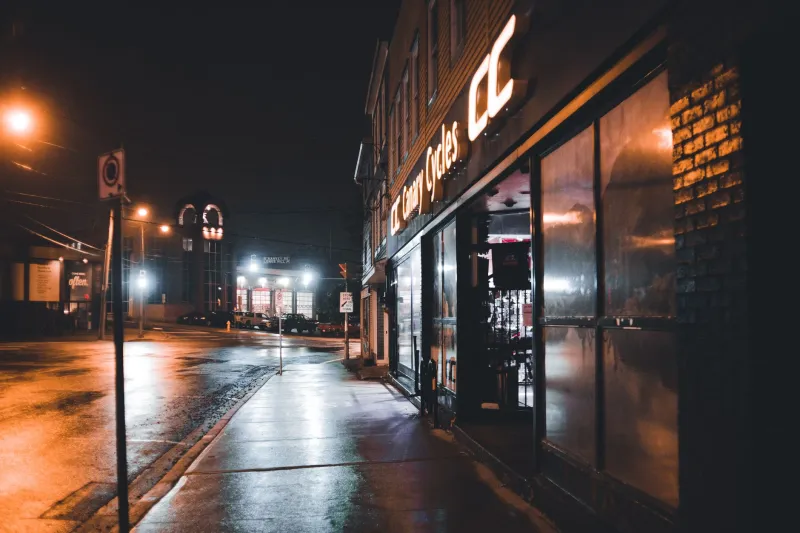
New York, Chicago, and Los Angeles each present a distinct geometric personality. Manhattan's grid of avenues and cross streets creates natural corridors of converging parallel lines, the kind that photographers have exploited since the era of the large-format view camera. The canyon-like stretches of Sixth Avenue or the elevated geometry of the High Line offer receding diagonals that draw the viewer's eye deep into the frame, creating a sense of depth that a flat surface would otherwise deny.
Chicago's architecture presents a different challenge and opportunity. The city's celebrated skyline and its intricate network of elevated train tracks — the iconic L — generate complex overlapping structures that reward photographers willing to search for the clean line within apparent clutter. The L's steel lattice, when positioned thoughtfully against a subject moving below, produces layered frames that feel both industrial and intimate.
Los Angeles, by contrast, is a horizontal city, sprawling and low-slung, where geometry manifests in the long shadows of late afternoon, the repetitive rhythm of palm trees receding toward a vanishing point, or the stark rectangles of freeway underpasses framing a solitary figure. The geometry is quieter here, but no less powerful for its subtlety.
Triangles: The Most Dynamic Shape in the Frame
If there is a single geometric form that recurs most insistently in accomplished street photography, it is the triangle. Unlike the static stability of a rectangle or the perfect equilibrium of a circle, the triangle carries inherent tension — its unequal angles create movement, directing the eye from point to point in a continuous circuit.
Street photographers frequently construct triangles from the relationship between subjects rather than from architectural elements alone. Three pedestrians positioned at different distances from the camera, a shadow falling at an oblique angle to a standing figure, or the diagonal of a staircase railing intersecting with a human silhouette — each of these configurations produces a triangular visual pathway that the brain finds naturally compelling.
The practical implication is significant: rather than waiting for a single decisive subject to appear, experienced photographers learn to read the triangular potential of a scene before anyone enters it. They position themselves where the light, the architecture, and the anticipated movement of people will converge into that dynamic three-pointed structure.
Symmetry and Its Deliberate Violation
Symmetry is one of the most immediately satisfying geometric devices available to a photographer, and American cities are filled with symmetrical facades, mirrored glass towers, and formally arranged public spaces. Grand Central Terminal's main concourse, the reflecting pool on the National Mall, or the paired colonnades of Chicago's Millennium Park all offer near-perfect bilateral symmetry that can serve as a powerful compositional anchor.
But the most interesting street photographs rarely rest in pure symmetry. Instead, they use it as a foundation and then deliberately disrupt it. A single figure positioned off-center within a symmetrical architectural setting creates immediate visual tension — the brain registers both the order of the symmetry and the disruption of the anomaly simultaneously. That dual awareness is precisely what holds attention.
This technique requires patience. The photographer must first identify a symmetrical environment, then wait — sometimes for many minutes — for a subject to enter the frame at exactly the right position to create productive asymmetry without destroying the underlying geometric order.
Negative Space as Active Geometry
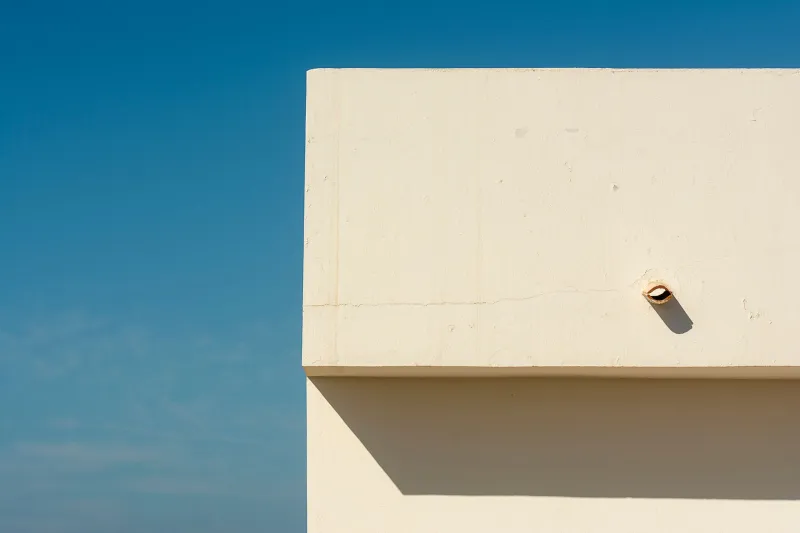
Negative space — the empty areas surrounding a subject — is perhaps the most underappreciated geometric tool in street photography. In the context of a busy urban environment, deliberately preserving empty space within a frame requires real discipline. The instinct is to fill the frame, to capture as much of the scene's energy as possible. Resisting that instinct, and instead allowing a large expanse of sky, pavement, or shadow to occupy significant portions of the composition, produces images of striking visual weight.
The geometry of negative space functions by implication. A small figure placed against a vast empty wall does not diminish the subject — it amplifies it. The eye, finding little else to rest upon, returns repeatedly to that solitary form. The emptiness becomes an active participant in the visual conversation rather than merely an absence of content.
Los Angeles street photographers have developed a particularly refined sensitivity to this technique, partly out of necessity. The city's wide boulevards and expansive architecture frequently dwarf human subjects, and photographers who learn to embrace rather than fight that scale disparity produce images of genuine visual power.
Training the Geometric Eye
For photographers looking to develop their own sensitivity to urban geometry, the process begins long before the camera is raised. It begins with looking.
A useful exercise is to walk a familiar urban block and identify every leading line visible from a single vantage point — the edges of sidewalks, the tops of parked cars, the horizontal bands of window sills, the diagonals of fire escapes. Most photographers, even experienced ones, find that a deliberate audit of this kind reveals far more geometric structure than they had previously registered consciously.
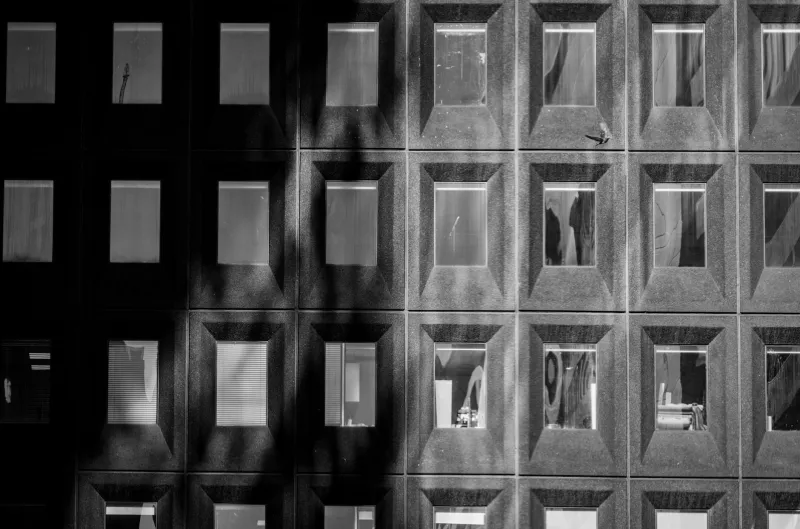
A second exercise involves isolating shapes. Before considering subject or light, identify every triangle, rectangle, and circle visible in a given scene. Notice how architectural elements create implied shapes through their spatial relationships. A doorway framed by two vertical columns and a horizontal lintel is a rectangle — but so is the shadow it casts, and so is the gap between two pedestrians walking in the same direction.
Finally, practice the discipline of the empty frame. Photograph scenes with no human subject present, focusing exclusively on the geometric relationships between architectural elements. This strips away the narrative distraction of human presence and forces genuine attention to pure form. When subjects eventually enter those geometrically prepared compositions, the photographer is already positioned to capture the moment when human spontaneity and geometric order briefly and beautifully coincide.
The Geometry Beneath the Surface
What separates great street photography from mere documentation is not simply the presence of a compelling subject or a fortunate moment. It is the photographer's ability to impose visual intelligence on an environment that offers none of its own. The city does not compose itself. It does not arrange its shadows, align its pedestrians, or balance its architectural masses for the benefit of anyone holding a camera.
That work falls entirely to the photographer. And the photographers who do it most consistently — who return from the streets of New York or Chicago or Los Angeles with images that feel both spontaneous and inevitable — are those who have internalized geometry so thoroughly that it operates as instinct rather than calculation.
The grid is invisible precisely because it has become second nature. The goal, for any serious student of street photography, is to make it invisible in exactly the same way: not by ignoring it, but by knowing it so completely that it disappears into the act of seeing itself.